




FAW Jiefang at 70: How China's First Truck Brand Shaped the Domestic Heavy-Duty Market and What Export Buyers Should Know
 By System Admin
2 months ago
By System Admin
2 months ago

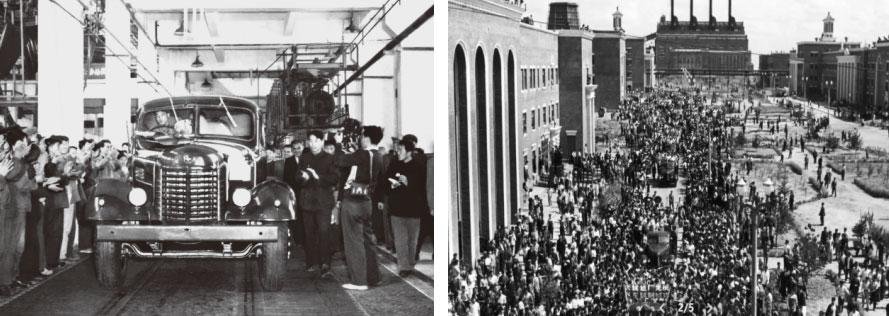
FAW Jiefang, a division of China FAW Group, traces its origins to July 13, 1956, when the first Jiefang CA10 truck rolled off the final assembly line in Changchun. That single event ended a long stretch in which the country could not produce its own trucks and set the direction for what is now one of Asia's most established commercial vehicle manufacturers. For international buyers evaluating Chinese truck brands, the history of Jiefang offers useful context on engineering continuity, model lineage, and the manufacturer's current strategic direction.

From the CA10 to the J7: A Concise Model Lineage
The earliest Jiefang trucks were built with substantial technical input from the Soviet Union, and the CA10 established a long production run that supplied Chinese road transport, construction, and military fleets for decades. By 1986, the second-generation CA141 was vertically transferred into production, followed by the third-generation CA150P, known colloquially as the "Liu Ping Chai," which entered production in Qingdao and Changchun in 1994 and 1995. The fourth-generation J4 arrived in 2002, and the fifth-generation Jie Fang Ou Wei followed in 2004.
Two later models are particularly relevant for international sourcing teams. The J6, unveiled in 2007, became a volume seller in domestic long-haul fleets and remains a familiar sight in many African, Central Asian, and Middle Eastern used-truck markets. The J7, launched in 2018 after roughly seven years of internal development, represents the current flagship heavy-duty platform. In April 2026, the J7 was officially introduced in Johannesburg, South Africa, signalling a renewed focus on the African commercial vehicle market.
Electrification, Hydrogen, and the "15333" Strategy
Jiefang's product roadmap has shifted noticeably toward alternative powertrains. In September 2021, the manufacturer published its "15333" new-energy strategy, outlining investment across battery electric, fuel cell, and hybrid technologies. In January 2024, the Xingyu concept truck provided a preview of future cab and chassis design, and in December 2024 the 6DV Super Factory began operations alongside the launch of the company's first hydrogen engine. By July 2025, the company had held a powertrain domain and product event, and in December 2025 it introduced the "Blue Path 3.0" new-energy platform. The Yingzhen product family, comprising the Yingtui, Yinghang, Yingteng, and Yingchi models, was unveiled in July 2025 for specific logistics applications. For buyers in 2026, this matters because new-energy variants are beginning to appear alongside the diesel range that still dominates the used-truck export trade.
What International Buyers and Fleet Operators Should Consider
For fleet operators in Africa, Southeast Asia, the Middle East, and Central Asia, where Jiefang trucks have been exported for years, the model lineage offers a degree of parts and service continuity. The J5 and J6 generations, in particular, are widely supported by independent parts suppliers outside China, which keeps maintenance costs predictable. The J7 platform is newer in export channels, so buyers should confirm local dealer coverage, warranty terms, and the availability of diagnostic tools before committing to larger orders.
Exporters and used-truck dealers should also note the shift in product mix. As Jiefang increases output of battery-electric and hydrogen-powered vehicles, diesel-heavy J6 stock is likely to remain the backbone of the second-hand market for the foreseeable future. Sourcing teams building inventories for African and South American buyers will continue to find strong supply of these diesel tractors and tippers, while early adopters in markets with charging infrastructure may begin to request newer electric variants. Verifying emission standard compliance, odometer authenticity, and engine type remains essential regardless of generation.
For dealers considering adding the brand to their portfolio, the South Africa launch of the J7 in 2026 suggests that the manufacturer is willing to support overseas market entry with new-model availability, not only legacy stock. Interested parties can review current listings of new and used Jiefang trucks and connect with established exporters through the CVTrader platform.
Explore available stock on CVTrader Vehicles, connect with verified partners on the Dealers Directory, or learn how to join the network at Become a Dealer.
Featured Vehicles