




China's New-Energy Heavy Truck Push Reaches Coal Transport Corridors: What Fleet Buyers Should Watch
 By System Admin
2 months ago
By System Admin
2 months ago
China's new-energy heavy truck sector is shifting from policy support to scaled, on-the-ground deployment. A joint plan issued by 11 ministries, including the Ministry of Transport, the National Development and Reform Commission, and the Ministry of Industry and Information Technology, sets a national target of more than 1.6 million new-energy heavy trucks in operation by 2030, with a penetration rate of 40 percent. To reach that level, annual additions would need to average above 200,000 units over the coming years. The plan also calls for more than 80 percent electrification on fixed-route short-haul corridors in regions such as the Beijing-Tianjin-Hebei area and the Fenwei Plain, alongside roughly 30,000 km of zero-carbon transport corridors and around 3,000 dedicated charging and battery-swap stations for heavy trucks.
For fleet operators and sourcing teams, the most important detail is the two-stage rollout strategy. Stage one focuses on short-haul transport, where fixed routes, short radii, high frequency, and controlled depot conditions make the operating economics of electric heavy trucks more straightforward. Stage two targets trunk-line logistics, including coal outflow corridors from Xinjiang, Shanxi, Shaanxi, and Inner Mongolia, as well as north-to-south grain corridors. The plan encourages large transport groups, express logistics companies, and scaled fleets to lead deployment, and supports battery leasing, vehicle-battery separation, and integrated energy services to reduce upfront purchase cost.
Inner Mongolia's Regional Roadmap and Coal Logistics Pressure
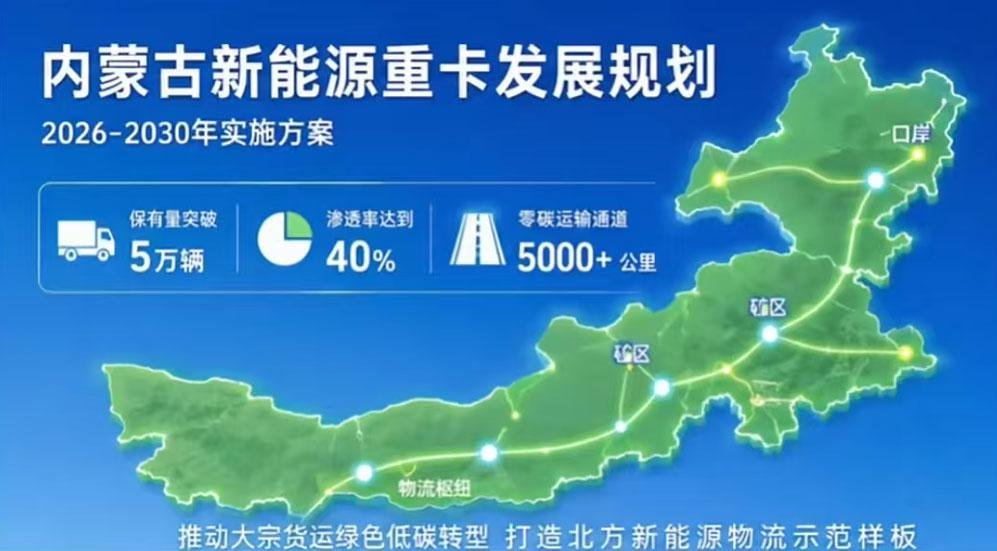
On 1 July, the Inner Mongolia Department of Transport led ten regional agencies in issuing the Inner Mongolia New-Energy Heavy Truck Scaled Application Implementation Plan (2026–2030). The regional plan targets 50,000 new-energy heavy trucks in operation by 2030 and a network described as three east-west corridors, four north-south corridors, and two connecting corridors, covering routes such as the G6 and G7 expressways and major border crossings, along with more than 5,000 km of zero-carbon transport channels.
Inner Mongolia is central to China's coal supply. Ordos alone produces more than 2 million tonnes of coal per day, and the region plays a structural role in national energy security. The push for new-energy trucks there is therefore both a response to national policy and a response to local operating pressure. Freight rates have softened while costs have continued to rise, leaving many logistics companies and owner-operators cautious about switching to electric models. Common concerns cited in the market include curb weight compared with diesel tractors, range uncertainty on long routes, and the wide variety of configurations available from different suppliers.
How One Manufacturer Structured Its Coal Transport Line-up
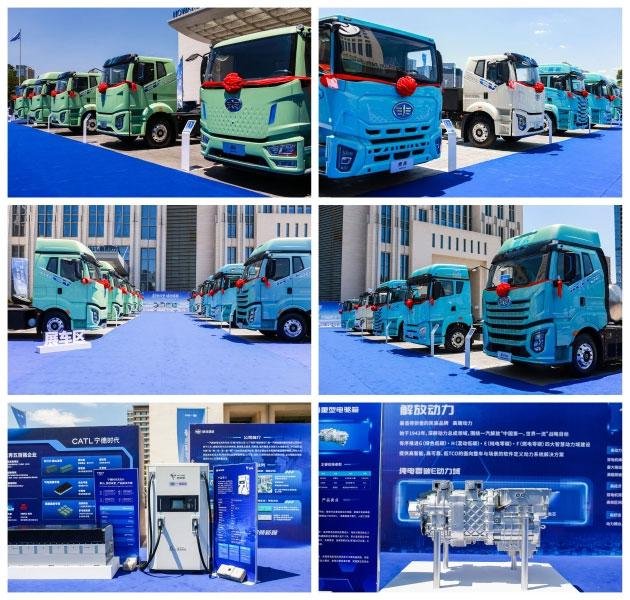
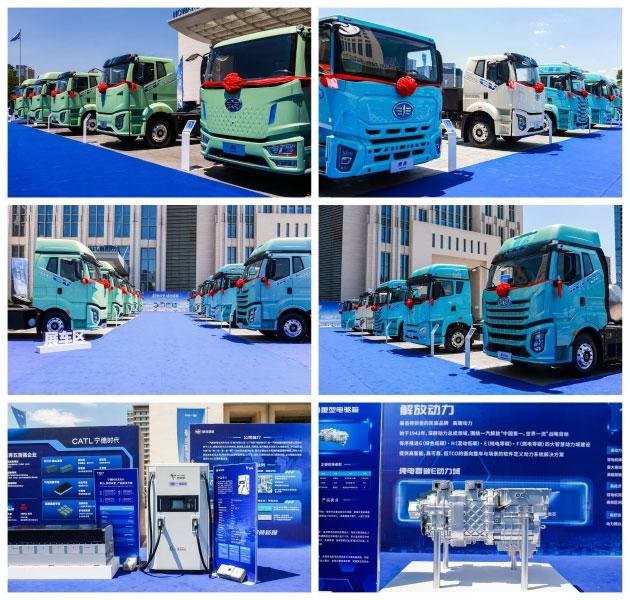
On 3 July, FAW Jiefang held a ceremony in Ordos marking 20,000 cumulative deliveries of new-energy heavy trucks and outlined a product matrix built around three operating scenarios and seven vehicle series.
For short-haul operations under 200 km, typically between mines, stockyards, and loading points, Jiefang presented the J6G Pro and Yingchi lines with three battery options. A 400 kWh charging version is positioned as a lightweight, high-payload option with a curb weight of 8.9 tonnes, allowing roughly half a tonne of additional coal per trip. A 410 kWh CTB configuration mounts the battery at the side to lower the vehicle's centre of gravity, while a 450 kWh CTB version is aimed at operators who want fewer charging stops per shift.
For intercity routes of 200–500 km, the J6 Pro and JH6 lines offer two parallel paths. A CATL 513 kWh battery-swap version targets routes with swap-station coverage and supports a roughly three-minute swap to keep vehicles in continuous operation. A CATL 615 kWh charging version is intended for corridors without swap infrastructure, where larger onboard capacity supports multiple trips per day.
For trunk-line routes above 500 km, Jiefang introduced a gas-electric hybrid J6 Pro, using CNG and electric power together to mitigate range concerns in regions with limited charging coverage, and the J6L and Yingtuo "mother and child" configuration, a lightweight paired-vehicle setup designed for compliant loading and reverse charging between the paired units. Across all three scenarios, the company highlighted in-house powertrain development, systematic lightweighting, and a nationwide service and charging network under its own "Jieyou" brand as supporting factors.
What This Means for International Buyers and Fleet Operators
For export dealers and overseas fleet operators, the Inner Mongolia programme is a useful signal. Coal and mining corridors produce some of the most demanding duty cycles for heavy trucks, including heavy payloads, repeated stop-and-go operation, and exposure to dust and temperature extremes. A product line that has accumulated 20,000 units in this environment provides a reference point for buyers evaluating Chinese new-energy heavy trucks for similar applications in other markets, particularly in regions with fixed mining or industrial routes.
Two feedback points from fleet customers at the Ordos event are worth noting for sourcing teams. Lin Caiyan of Inner Mongolia Shiyi Trading, a company with 21 years of heavy truck export experience supplying coal-haul operations into Mongolia, highlighted the breadth of the new-energy range, including electric drive axles, range-extended models, and mother-and-child configurations, as a factor in supplier selection. Li Yu of Ordos Juhui Coal Transport stated that his company ordered the J6G Pro electric-drive-axle model based on expected energy consumption and operating cost, with plans to expand the fleet to 300 new-energy units over the next two years.
For fleet managers outside China, the practical takeaways are straightforward. National targets and regional plans are now backed by specific charging and swap-station build-out, which will gradually reduce range uncertainty on selected corridors. Vehicle-battery separation, battery leasing, and integrated energy services are being promoted as standard commercial models, which is relevant for buyers structuring total cost of ownership calculations. Configurations such as side-mounted batteries, battery-swap versions, gas-electric hybrids, and paired-vehicle systems give operators more tools to match truck specification to route profile rather than accepting a single platform.
Browse the current selection of new-energy heavy trucks on CVTrader Vehicles, connect with verified Chinese exporters via the Dealer Directory, or list your own supply on Become a Dealer to reach international fleet buyers evaluating Chinese commercial vehicles.
Featured Vehicles