




Foton Auman Galaxy 5M Electric Heavy Truck Refresh: What It Means for Fleet Buyers
 By System Admin
5 months ago
By System Admin
5 months ago
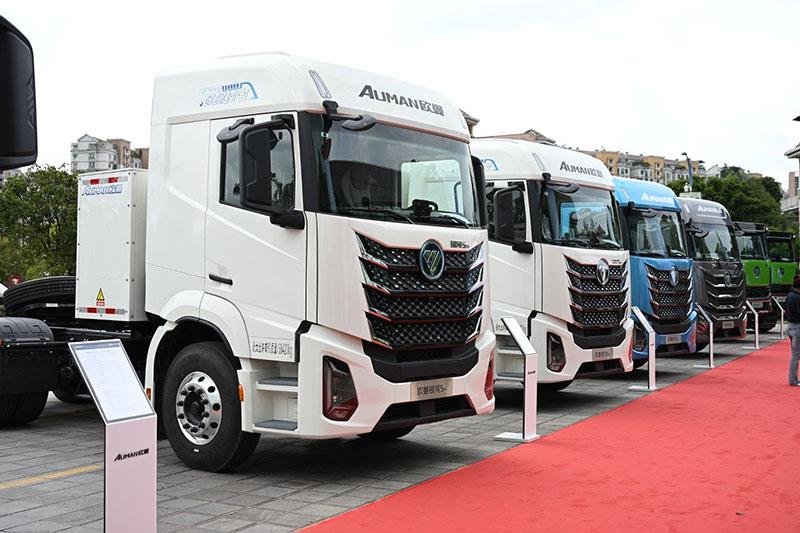
An updated version of the Foton Auman Galaxy 5M heavy-duty electric tractor has been released in the Chinese market, with two configurations designed for different operating environments. The launch targets common pain points reported by electric truck operators and addresses a wider set of duty cycles than the previous model. For international buyers, dealers, and fleet managers evaluating imported or cross-border electric heavy-duty options, the announcement offers a useful snapshot of where Chinese OEMs are focusing their development resources: charging speed, thermal management, and lighter weight bodies.
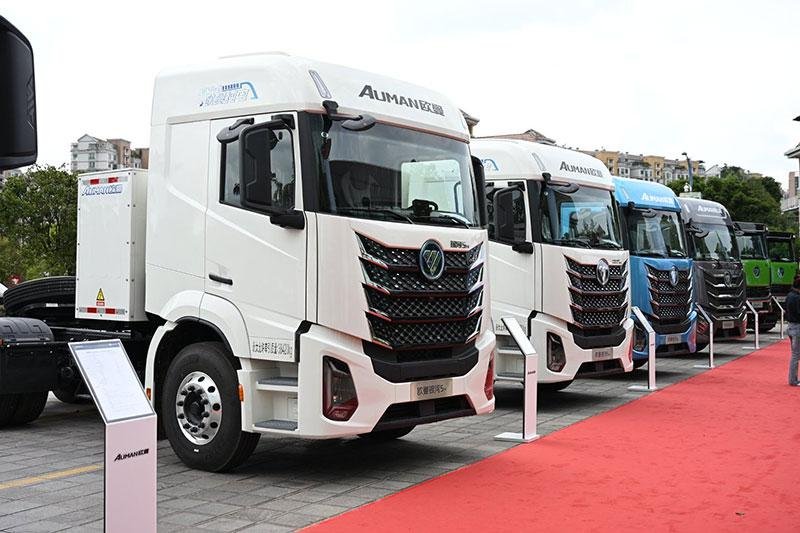
Rather than positioning the vehicle as a single product, the manufacturer is framing it as a platform with two variants. One version targets high-intensity operations such as port transfer, coal haulage, and aggregate tipping, where vehicles run continuously and depend on fast turnaround. The second version is aimed at general cargo, regional logistics, and inter-city flows that must cope with mixed routes and wide climate variation. Both versions share an emphasis on shorter charging windows and reduced empty weight, two factors that directly influence total cost of ownership in fleet operations.
528 kWh Megawatt Super-Charging Variant
The first variant carries a 528 kWh battery pack and is described as using megawatt-class super-charging technology integrated with Huawei's super-charging network. The truck uses a direct-drive electric axle architecture and supports a 3.5C peak charging rate. According to the manufacturer, a 10 to 80 percent state of charge can be reached in roughly 18 minutes or less under suitable conditions, with a claimed improvement of more than 3 percent in combined charge-discharge efficiency compared with prior systems.
For duty cycles that require long daily working hours, the vehicle is equipped with a 3D thermal management system, a dedicated super-charging pole architecture, and thermal-conductive electrolyte technology aimed at reducing heat build-up during high-load operations. The manufacturer highlights dual-source isolated heat exchange, designed with separate cooling loops for the vehicle and the charging station to prevent coolant mixing. A warranty of eight years or 4,000 cycles, capped at 1.8 million kWh, is offered for the battery system, which the company states can extend overall service life by 10 to 15 percent under typical fleet use.
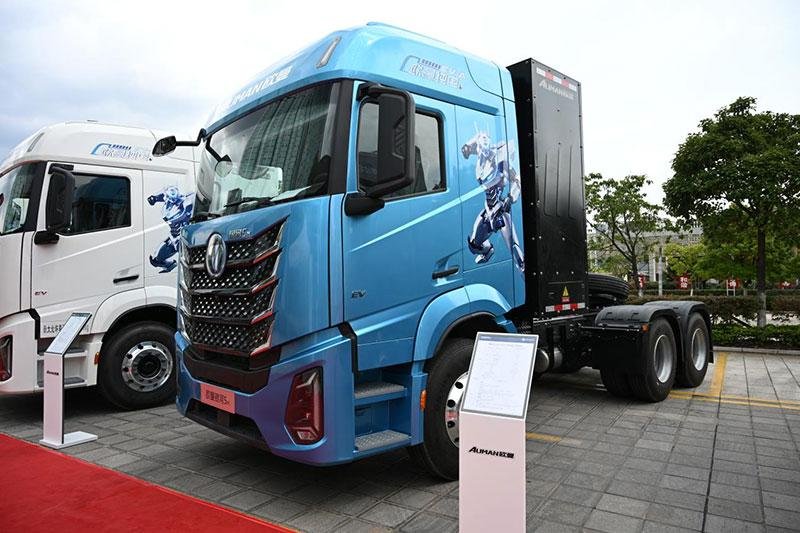
400 kWh and 600 kWh Fast-Charging Variants
The second family is the Aiyike 400 kWh and 600 kWh fast-charging variants, developed for general cargo fleets and operators with mixed route profiles. Weight reduction is a central focus. The manufacturer describes the use of high-strength alloy structures, maintenance-free lightweight wheel ends, a glass-fiber-reinforced polypropylene composite skin, and an integrated multi-function electronic control unit. Combined, these measures are claimed to reduce kerb weight by more than 200 kg without compromising structural strength, which the company says translates into lower empty-load energy consumption and greater legal payload capacity.
Charging performance centers on a 1.25C rate and dual 800A connectors. Compared with a conventional 600A charging setup, the dual-gun configuration is said to reduce charging time by roughly 11 minutes per session, a figure relevant to short-haul operators making multiple stops per shift. The thermal package uses microporous insulation materials and a foam damping structure rated for stable charging at minus 20°C and continuous operation between minus 35°C and 60°C. The body has been tested at three times the older Chinese national standard for structural strength, with cavity foam filling intended to reduce internal condensation and corrosion risks.
Implications for International Fleet Operators and Sourcing Teams
For buyers outside China, the announcement is less about immediate availability and more about benchmark data. The focus on charging rate, cold-weather tolerance, and weight reduction mirrors the priorities of European and Middle Eastern fleet operators evaluating battery-electric tractor units. Specific items worth tracking include real-world energy consumption per kilometer, third-party validation of the 3.5C charging claim, and the availability of compatible high-power charging infrastructure in target export markets.
Fleet managers considering imported electric tractors should also weigh warranty terms carefully. The cited eight-year or 4,000-cycle battery warranty is competitive in the global heavy-duty segment, but cross-border service support, spare parts logistics, and access to authorized high-voltage technicians will be decisive factors for total cost of ownership. Sourcing teams are advised to confirm certification status for destination markets before committing to volume.
The broader direction is clear: Chinese heavy-duty OEMs are moving from single-configuration electric trucks toward a configurable platform approach, similar to established European manufacturers. Buyers and dealers monitoring this segment should expect more variants, faster charging iterations, and greater attention to total operating economics rather than headline battery size alone. CVTrader will continue to track specifications, availability, and export readiness of these models as further information emerges.
Explore current listings on CVTrader at /vehicles, review approved exporters at /dealers, or learn how to join the network at /become-a-dealer.
Featured Vehicles