




Yutong's Premium Bus Push: What International Buyers Should Take from the S12 Story
 By System Admin
8 months ago
By System Admin
8 months ago
Inside one of Yutong's assembly halls, a T-series premium coach in a deep glaze-blue finish shares a line with a blue-and-white city bus. Different models, different specifications, but the same production line. For international buyers watching the Chinese bus market, that single image captures the central message: Yutong is no longer a low-cost, high-volume supplier. It is repositioning its portfolio around premium segments, and using the S12 flagship to demonstrate what that shift looks like in practice.
For decades, the global premium coach segment has been associated with European brands. Yutong has spent years working to change that perception, starting with the T7, which served national-level events in China for eleven consecutive years. The T7 proved that a Chinese manufacturer could build a high-end coach for the most demanding clients at home. The S12 is the next step, aimed at international recognition rather than domestic validation.
Design Built Around User Experience, Not Aesthetics Alone
The S12 program reportedly began with color selection. The design team studied traditional architecture, natural landscapes, and ceramic finishes, working through a large palette of candidate colors before narrowing them down to six production options. The chosen finishes, including a signature glaze blue that shifts appearance under different light conditions, were evaluated across weather and lighting conditions for more than a hundred days before approval.
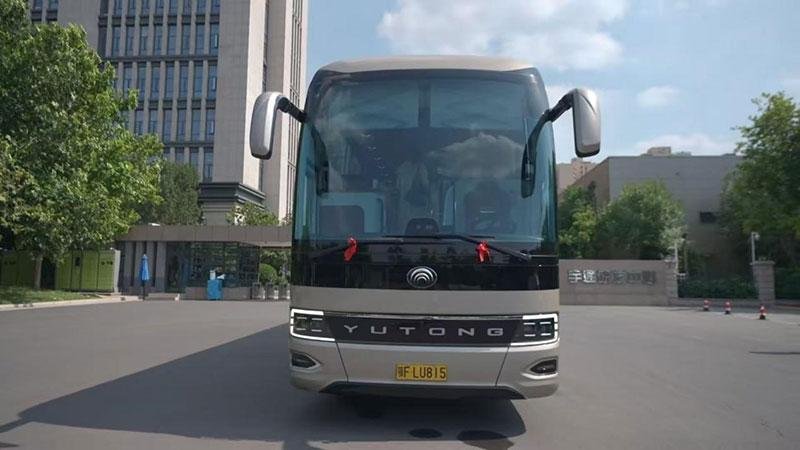
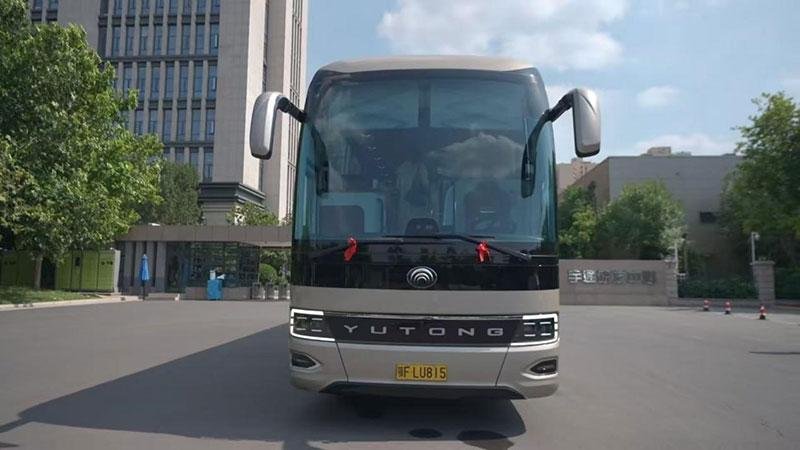
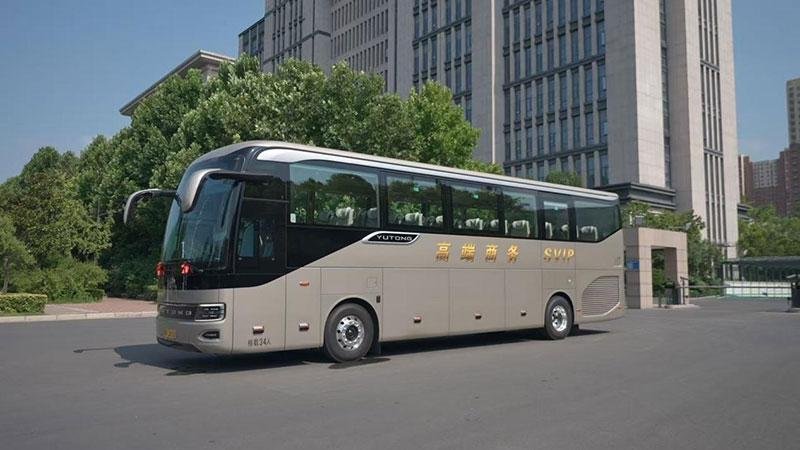
Body proportions were developed around a 0.618 golden ratio, with attention to interior space. Yutong highlights headroom that allows tall passengers to stand upright, side glass area of around 18.4 square meters, an idle cabin noise level close to a library environment, and a ventilation system designed for long-haul comfort. The S12 has received the international CMF Design Award, described as the first time a Chinese bus brand has won that recognition. For buyers, the practical question is whether these features translate into commercial value: passenger comfort, longer route acceptability, and stronger brand image for operators.
Manufacturing Standards Unified Across the Range
Bus production differs from passenger car production in one important way: high model variety, small batch size. Yutong lists more than a hundred active models. A single line may produce city buses one day and tour coaches the next, each with different paint, seating, and configuration requirements. Historically, this created heavy reliance on operator experience and manual coordination. Since 2019, Yutong has been converting that accumulated know-how into structured data and process control.
Welding is now handled by more than 200 robots, with seam precision controlled within 0.5 millimeters. The time needed to program a single weld has reportedly dropped from several hours to about one minute. Paint application is fully automated, which the company links to a consistent mirror-grade finish across models. Glazing installation, a critical point for long-term reliability, has moved from manual application, with tolerances around 2.5 millimeters, to robotic application using 3D vision, with tolerances reduced to roughly 1 millimeter. The point of these investments, for export buyers, is consistency. Specifications shown in a tender document should match the vehicle delivered, regardless of which model leaves the line that day.
Market Position and What It Means for Sourcing Decisions
China's imported commercial vehicle market has shrunk to a very small volume in the first half of the year, compared with several hundred to over a thousand units a year two decades ago. That shift reflects a broader change in the domestic bus market, where Chinese-made high-end coaches have replaced joint-venture products in segments that used to be dominated by European brands. In Europe, Yutong reports selling electric buses at price parity with mainstream European brands and leading the segment in unit sales.
Every Yutong bus is said to undergo around 40 kilometers of mixed-condition testing before delivery, covering high-speed loops, gradients, washboard surfaces, rough terrain, and water immersion. For fleet operators, the more relevant question is not whether a flagship model performs well in a controlled demonstration, but whether the same standard is applied to a 12-meter city bus, a school bus, or a tourism coach. According to Yutong's public statements, the answer is yes. The S12 serves as a public benchmark, but the underlying systems are intended to flow through the rest of the range.
For international buyers, this matters in three ways. First, the price gap between Chinese-built premium coaches and European brands is narrowing, while the configuration and build quality are rising. Second, export support structures, including after-sales networks and parts supply, are a critical part of the total cost calculation and should be reviewed before purchase. Third, the wider Chinese bus industry is moving from a volume-driven export model to a value-driven one, which should lead to more stable residual values for well-supported brands.
Whether the S12 becomes a common sight on European motorway routes or Latin American intercity corridors will depend on dealer networks, financing options, and local service capability. For dealers and fleet operators evaluating Chinese suppliers, the underlying message is straightforward: the products have changed, the production systems have changed, and the competitive benchmark has moved upward.
Explore current bus and coach listings on CVTrader, review verified dealer profiles, or apply to become a dealer to expand your sourcing reach in the global commercial vehicle market.
Featured Vehicles