




Yutong New Energy Commercial Vehicles Complete Sichuan-Guizhou Durability Challenge: What Fleet Buyers Should Take Away
 By System Admin
4 months ago
By System Admin
4 months ago
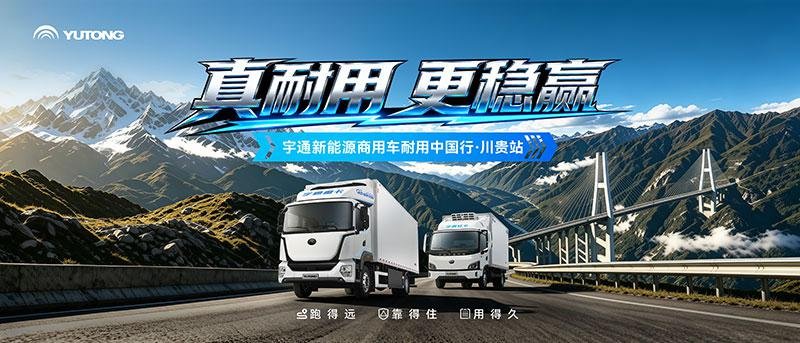
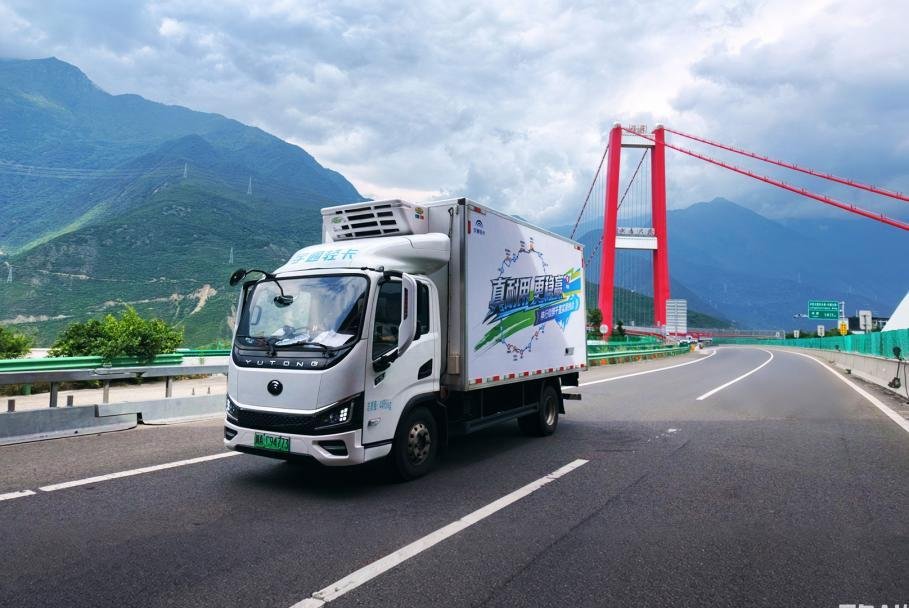
Between July 7 and 9, 2026, Yutong ran a dual-route field validation campaign for its new energy commercial vehicles in the Sichuan and Guizhou regions of southwestern China. Rather than a controlled demonstration, the activity used real cold-chain delivery routes operated by an existing logistics customer, ChengDu ShunFa Tuozhan Transport. Two vehicle families were tested in parallel: the Yutong Shenxing T5 176 electric light truck on an 800 km western Sichuan loop, and the Yutong Tianxing C331 electric heavy truck on a 1,800 km Sichuan-Guizhou line. The aim was to verify durability, range stability, temperature control, and operating cost under the kind of mountainous, high-altitude, and high-temperature-variation conditions that define freight in this part of China.
What the two routes actually tested
The Shenxing T5 176 refrigerated light truck ran an 817 km round trip from the Chengdu Plain up to the Zheduo Mountain pass at 4,298 meters, carrying a 1.3-tonne load with three independent temperature zones. Ambient temperature shifted from 36°C at the base to 8°C on the plateau, and the route covered five drop-off points in roughly 20 hours. Cold-chain temperature fluctuation stayed within plus or minus 0.5°C, average energy consumption translated to about 2.76 km per kilowatt-hour, and the reported per-kilometer operating cost was around 0.37 RMB. The Tianxing C331 refrigerated heavy truck covered 1,591.7 km from a Yzuo Foods warehouse in Chengdu across five cities into the Yunnan-Guizhou plateau, including a 40 km continuous climb with a 700-meter elevation gain and nine drop-off points over about 33 hours. Cold-chain deviation was reported at plus 0.5°C, average energy use at 0.57 kWh per kilometer, and per-kilometer cost at roughly 0.54 RMB. Both vehicles completed their routes with zero delays and zero cargo loss.
How Yutong frames "durability" for fleet buyers
For fleet operators, the more useful framing sits behind the route numbers. Yutong breaks its durability claim into three measurable criteria: range you can trust, uptime you can plan around, and service life that lowers total cost of ownership. On the light truck side, the T5 176 is built around a 175 Wh/kg high-specific-energy battery, a 98.2% efficient flat-wire motor, and a 99.5% integrated seven-in-one controller, with a Kalman-filter SOC algorithm that the company says keeps the last 1% of indicated range usable rather than unusable. For refrigerated transport, the Tianxing C331 reportedly delivers more than 400 km of range under active cooling, supported by 97.5% SOC accuracy and a low drag coefficient. Temperature control across both vehicles is rated at plus or minus 0.5°C, including through frequent door openings on multi-stop routes.
What this means for international fleet decision-makers
For buyers outside China, the campaign is best read as a stress test rather than a sales claim. High-altitude climbs, long grades, sharp temperature swings, and continuous refrigeration are conditions that appear in many emerging logistics corridors, from Andean cold-chain lanes to cross-border African reefer routes. The reported metrics worth tracking for your own evaluation are straightforward: average kWh per kilometer under load, temperature stability during multi-stop delivery, per-kilometer operating cost, and the residual-value case after five to ten years. Yutong states that its three-electric system is designed for a 15-year or 1.5 million km service life, that light-truck cells are rated for 9,000 cycles, and that warranty coverage extends up to 10 years or 1 million km, which directly affects depreciation modeling.
Independent verification matters as much as the headline figures. Fleet sourcing teams should request third-party telematics data from comparable routes, ask for reference customers running similar payloads and climates, and confirm warranty terms in writing, including battery state-of-health thresholds at year five and year ten. The Sichuan-Guizhou results are a useful benchmark, but they are a single event under one set of conditions, and total cost of ownership conclusions should be built on your own duty cycle, electricity price, and maintenance assumptions rather than on any single demonstration run.
For dealers, exporters, and fleet managers tracking the new energy commercial vehicle segment, events like this highlight how Chinese OEMs are increasingly competing on documented real-world performance rather than on laboratory specifications alone. If you are evaluating electric light trucks or heavy-duty reefer platforms for cross-border or emerging-market operations, CVTrader's vehicle listings make it easy to compare available models side by side. Browse current new energy commercial vehicles for sale, connect with verified commercial vehicle dealers worldwide, or apply to become a dealer on CVTrader to expand your sourcing reach.
Featured Vehicles